 South Korea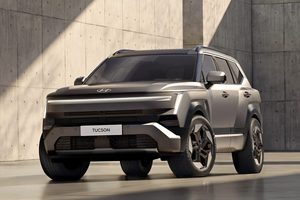
Hyundai released the first official images of the fifth-generation Tucson on 19 August 2026, six years after the current car arrived. Two things changed measurably: the design language and the size. The engines were not part of the announcement.
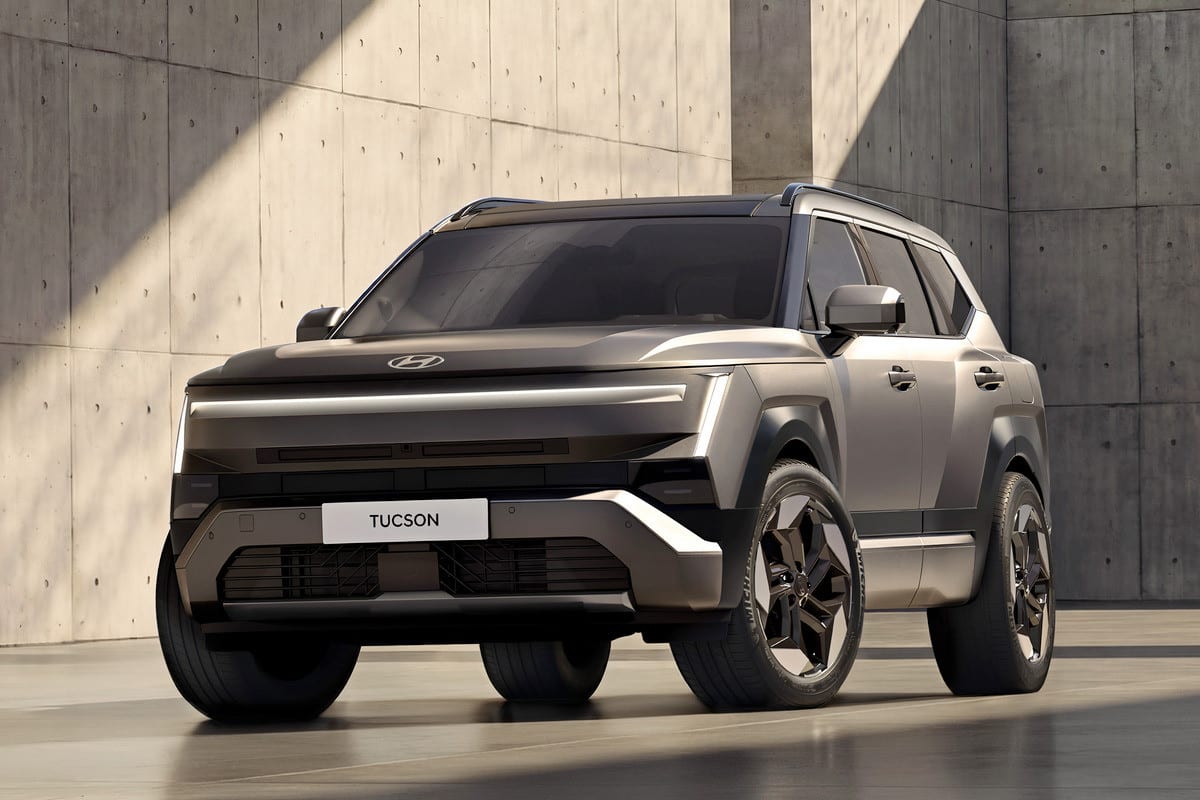
The styling is Art of Steel, the language Hyundai has so far shown only on concepts, and the Tucson is the first production car to carry it. In place of the outgoing car’s rounded body and creased surfacing there is an upright two-box shape with thick bumpers and deep side skirts. Vertical H-edge daytime running lights sit at each corner of the nose and tail, linked by a slim horizontal bar, so the running lights are no longer buried in the grille.
Bigger in every direction
The new car is 4,700 mm long, 1,905 mm wide and 1,685 mm tall on a 2,785 mm wheelbase: 60 mm longer, 40 mm wider and 20 mm taller than the outgoing global Tucson, with 30 mm more between the axles. These are the global car’s figures, and they do not line up with the North American fourth-generation Tucson’s 4,641 mm, which is a differently packaged version of the older car.
Hyundai spent part of the growth on access rather than on cargo numbers. Second-row headroom is quoted at 1,031 mm, up 29 mm, and the rear doors now open to 83 degrees instead of 73. The extra ten degrees is the difference between angling a child seat through the gap and lifting it straight in, and it is what makes the back row usable in a tight parking bay.
The screens come apart
The merged curved display housing is gone. A slim driver display sits high ahead of a double-D steering wheel, separate from a large central touchscreen running Hyundai’s Pleos Connect software, and physical dials and switches survive underneath it for volume, fan speed and temperature. The gear selector moves to a stalk on the steering column, which frees the console for two wireless charging pads, and a card holder replaces the accessory panel beside the driver’s air vent. Buyers get eight exterior colours, five of them new, and four interior combinations.
An XRT from the start
The rugged XRT trim was shown alongside the standard car rather than held back. It has a rectangular-motif grille, a wide front skid plate, black wheel-arch garnishes in a forged-carbon pattern, its own alloy wheels and a reworked rear bumper, plus patterned seats, dark metal trim, protective floor mats and touch-sensitive LED lighting on the tailgate.
What is missing is everything mechanical. Hyundai named no petrol, hybrid or plug-in hybrid variant, published no outputs or prices, and gave no premiere date or launch market. Until it does, the fourth-generation car is the one on sale.

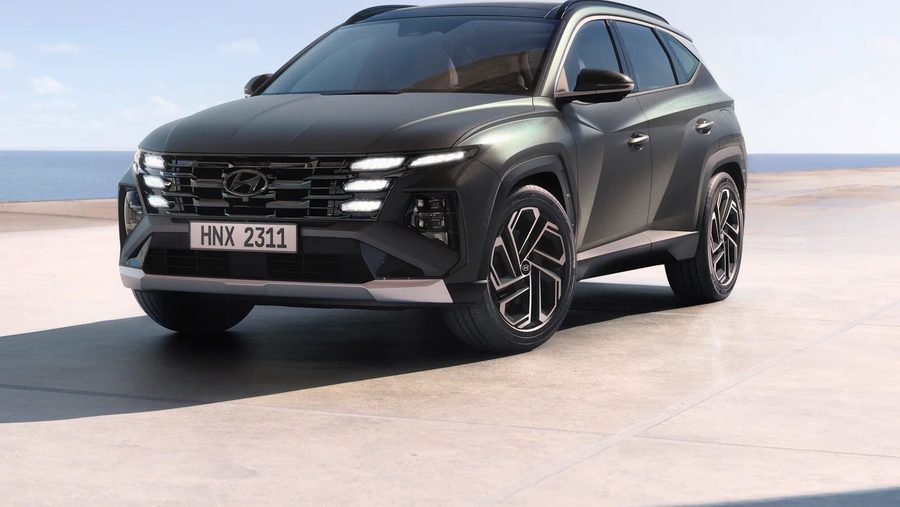
The fourth-generation Hyundai Tucson (2026 model year, North America) is a compact SUV offered with a 187 hp 2.5-litre petrol engine or a 231 hp 1.6-litre turbo hybrid, both available with all-wheel drive. US pricing starts at $29,450 for the base gas SE and $32,450 for the Blue SE hybrid.