 Japan
Japan
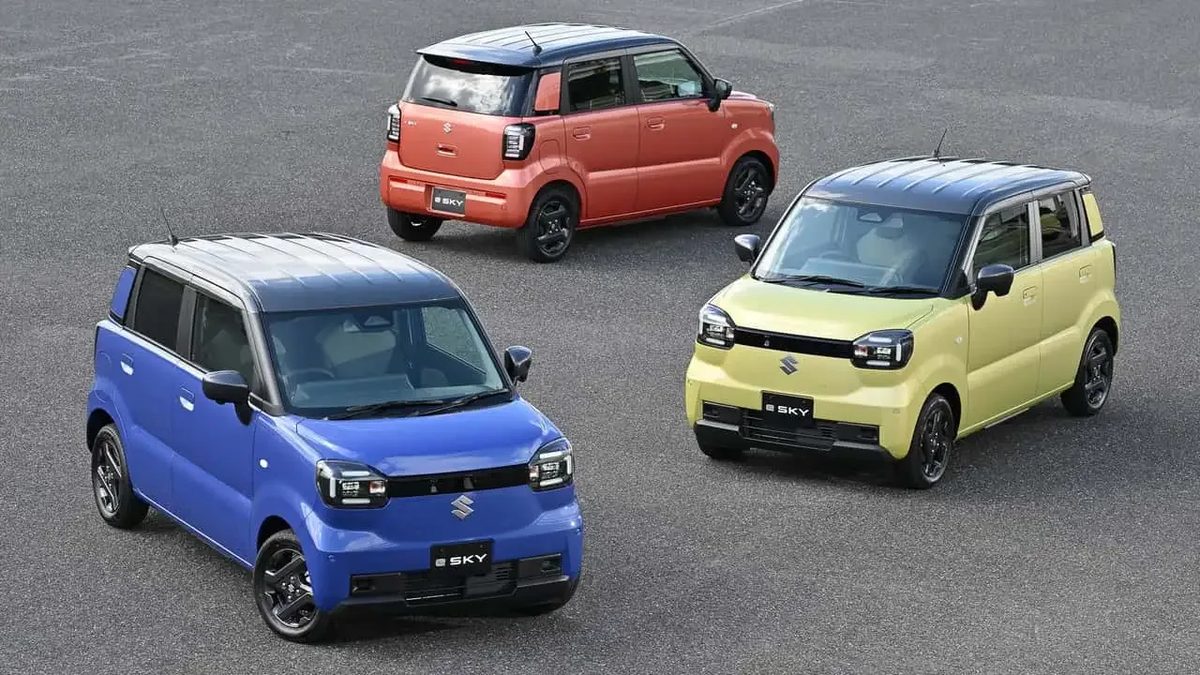
Suzuki released advance details of the e SKY on 24 August, the company’s first battery-electric kei passenger car. It quotes 310 km of range on Japan’s WLTC cycle from a 26 kWh lithium iron phosphate battery, in a car that weighs 1,030 kg.
Those numbers are provisional. Suzuki calls them reference values for the current stage of development and says they may change before the car reaches the market. The full specification and the price are due with the formal announcement, scheduled for autumn 2026.
Range, battery and charging
The battery sits under the floor and uses lithium iron phosphate chemistry, which is cheaper and more durable than the nickel-based cells common in larger EVs, at the cost of energy density. In a kei car that trade-off is easier to accept, because Japan’s light-vehicle rules cap the body at 3,400 mm long and 1,480 mm wide and there is no room for a big pack anyway. The e SKY measures 3,395 x 1,475 x 1,625 mm on a 2,460 mm wheelbase and turns in a 4.4 m radius.
Suzuki also quotes energy consumption of 97 Wh/km, which it describes as class-leading. Charging takes about eight hours from a 3 kW domestic supply, about 4.5 hours from a 6 kW wallbox, or roughly 25 minutes to reach 80 percent on a 50 kW DC charger. A 100 V, 1,500 W household socket in the cabin lets the car run appliances or tools off the traction battery, and the dashboard carries a 10.1-inch display audio unit.
What Suzuki has not said
Motor output is not in the advance release. Kei regulations cap power at 64 PS, or about 63 hp, so the ceiling is known even though the figure is not. Price is also absent, and Suzuki has committed only to announcing it in autumn.
The production car follows the Vision e-Sky concept shown in 2025, with the show car’s illuminated grille and elaborate lighting replaced by simpler headlamps and conventional cabin materials.
The reported plan for Europe
Suzuki has not announced sales outside Japan. Nikkei Asia, citing people familiar with the matter, has reported that the company intends to export the car to Europe from 2027, with the United Kingdom and Italy under consideration and a British price below GBP 20,000. The same report says the export cars would be built at a plant southwest of Tokyo, with cells from BYD’s supplier network. None of that is confirmed by Suzuki.
If it happens, it would be the first time Suzuki has sold a near-unchanged kei car in Europe since the Cappuccino ended in 1995.